turning “data about data” into structure, rules, and ready-to-use output ports
Most data teams have pieces of the puzzle:
a catalog with technical metadata a wiki with business context naming conventions in someone’s head governance rules in a PDF and business logic living in notebooks, SQL, or dashboards
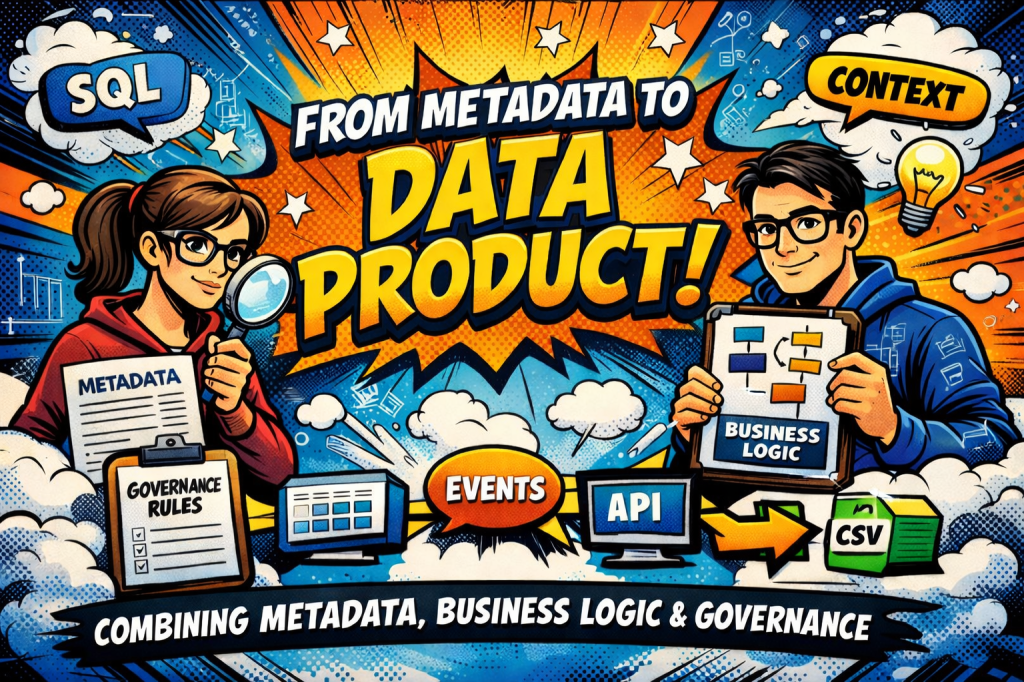
Individually, those pieces are useful. But the real leverage happens when you combine them into something actionable: a proposed Data Product structure (datasets + semantics + responsibilities) and a set of Output Ports (tables, APIs, events, files) that people can actually subscribe to with confidence.
This post is about exactly that: how to stitch metadata, business logic, governance, conventions, and business context together so you can propose (and later generate/validate) a Data Product design that is consistent, compliant, and human-friendly.
The real problem: we ship data, but we don’t ship “understanding”
When teams say “we have metadata,” they usually mean column names, types, lineage, run history, maybe a few tags. That’s a good start, but it doesn’t answer the questions consumers actually have:
What does this dataset mean in business terms? What can I use it for and what should I never use it for? Which rules are applied? Which filters? Which privacy constraints? How stable is it? What changes are breaking? Which output should I subscribe to: table, API, event stream?
A Data Product should answer those questions by design.
The trick is: a Data Product is not just data. It’s a packaged promise.
And the packaging is where your “ingredients” finally become a meal.
The 5 ingredients you already have (but rarely connect)
Let’s name the building blocks:
1) Data metadata (technical truth)
This is your “what exists” layer:
schemas, keys, nullability lineage / upstream dependencies freshness, SLA, last successful runs volume, drift, quality checks usage telemetry (who uses what)
Value: helps you understand shape, stability, operational characteristics.
2) Business logic (transformation truth)
This is your “how it’s made” layer:
transformation steps (SQL, notebooks, pipelines) mapping rules (source → target) aggregation logic derived metrics definitions exception handling
Value: explains why fields exist and how values are computed.
3) Governance rules (permission and policy truth)
This is your “what’s allowed” layer:
classification (PII, sensitive, regulated) access model (RBAC/ABAC), row/column-level security retention rules consent constraints allowed use cases / prohibited use cases
Value: makes the product safe and auditable.
4) Conventions (consistency truth)
This is your “how we name and structure things” layer:
naming conventions domain boundaries and ownership medallion/layering expectations versioning rules contract standards
Value: keeps products discoverable, predictable, scalable.
5) Business context (meaning and intent)
This is your “why it matters” layer:
business object definitions glossary terms process context (where in the business flow) KPIs and decision scenarios stakeholder map (owners, SMEs, consumers)
Value: turns datasets into something humans understand and trust.
The mindset shift: proposing a Data Product is a design exercise, not a documentation task
When you combine those ingredients, you stop “documenting after the fact” and start designing forward.
A good proposal answers:
What is the Data Product boundary? (domain + scope + responsibility) What are the canonical entities and relationships? (business objects) What outputs should exist, for which consumers? (output ports) What contract and governance applies? (rules, SLAs, quality, access) What conventions make it consistent with the rest of the mesh?
This is exactly where metadata becomes more than a catalog entry: it becomes a blueprint.
A practical blueprint: how to go from “inputs” to “proposed structure”
Here’s a workflow you can apply without needing fancy tooling first.
Step 1: Start with the business object, not the table
Pick the business object (or “core concept”) you are serving:
Customer Policy Claim Appointment Invoice LessonPlan (if you’re in edu)
Your Data Product should align to a business object or a coherent set of objects.
Output: a short “Business Object card”
definition in plain language identifiers (natural + surrogate) key attributes lifecycle events (created, updated, closed) typical questions it answers
Step 2: Overlay technical metadata to find the real sources of truth
Use lineage + schemas to identify:
upstream systems that define the object competing sources (multiple “truths”) key consistency (IDs, keys, joins)
Output: a “source-of-truth decision”
which source defines which attributes what is mastered vs referenced what is derived
Step 3: Extract business logic into “semantic rules”
Don’t dump SQL into docs. Turn it into rules people can reason about:
“Status is calculated based on X and Y” “Amount is gross minus discount, rounded to 2 decimals” “Only records with valid consent are included”
Output: a semantic rule list (human-readable, testable)
Step 4: Apply governance early to shape the product
Governance is not a layer you add later. It changes structure.
Examples:
PII means you may need two output ports: one restricted, one privacy-safe retention rules may require: a “current state” output and a “historical snapshot” output access constraints may push you toward: aggregated outputs instead of raw detail
Output: a governance profile
classification per attribute allowed audiences masking/tokenization requirements retention and audit needs
Step 5: Use conventions to standardize the “packaging”
This is where you avoid “every Data Product looks different”.
Conventions typically influence:
folder structure / namespaces dataset naming contract files (schema + semantics + SLA) versioning strategy port naming patterns
Output: a standardized skeleton everyone recognizes.
Designing Output Ports: stop thinking “one dataset”, start thinking “consumer interfaces”
A Data Product can have multiple Output Ports, just like a service can have REST + events + batch exports.
A simple, powerful pattern is to define ports by consumer needs:
1) “Analyst-ready” port (stable, wide, documented)
denormalized or well-modeled includes business-friendly names strict SLA and quality checks great for BI and ad-hoc analysis
2) “Operational / API-like” port (narrow, fast, controlled)
focused on key use cases often filtered, secured, near-real-time good for apps and downstream automation
3) “Event” port (change-driven, decoupled)
emits business events (“ClaimSubmitted”, “PolicyCancelled”) great for reactive architectures requires strong contracts and versioning
4) “Privacy-safe” port (shareable, minimal risk)
aggregated, masked, or anonymized ideal for broader internal access or partners
Key point: governance and context should directly inform which ports exist.
If you only publish one port, you often force consumers into unsafe or inefficient usage patterns.
What your final “proposal package” should look like
If your goal is a proposal that can be reviewed, implemented, and evolved, it should contain:
Data Product Overview
purpose, scope, domain target consumers and use cases owner + support model
Business Object Model
glossary-aligned definitions identifiers, relationships, lifecycle
Output Ports (each as a contract) For every port:
schema (fields + types) semantics (definitions + calculation rules) SLA (freshness, availability) quality expectations (checks, thresholds) access rules (who can see what) change policy (versioning, deprecations)
Lineage & Dependencies
upstream systems transformation assets (pipelines/notebooks) critical dependencies and failure modes
Conventions Compliance
naming, structure, tagging, ownership how it fits into the wider mesh
This is the moment you’ll notice something interesting:
The Data Product becomes reviewable like software.
You can do design reviews, contract reviews, governance reviews—before shipping.
Why this matters: speed comes from clarity, not shortcuts
Teams often think governance and documentation slow them down. In reality:
unclear semantics cause rework unclear ownership causes delays unclear access rules create security risk unclear quality causes distrust (and shadow pipelines)
When you combine metadata + logic + governance + conventions + context into a structured proposal, you get:
faster onboarding for consumers fewer “what does this mean?” meetings safer self-service easier automation (validation, scaffolding, CI checks) a mesh that looks and feels like a product ecosystem
A simple way to start tomorrow
If you want a lightweight first step:
pick one business object define two output ports (analyst-ready + privacy-safe) write the semantic rules in plain language tag every attribute with classification standardize naming/versioning from day one
That’s enough to shift from “datasets” to “products”.
Closing thought
Metadata alone tells you what you have.
Business logic tells you how it’s made.
Governance tells you what’s allowed.
Conventions tell you how it should look.
Business context tells you why it matters.
When you combine them, you don’t just document data—you design Data Products that people can trust, subscribe to, and build on.
 Data As A Product Guy
Leave a comment