(Without Losing Control)
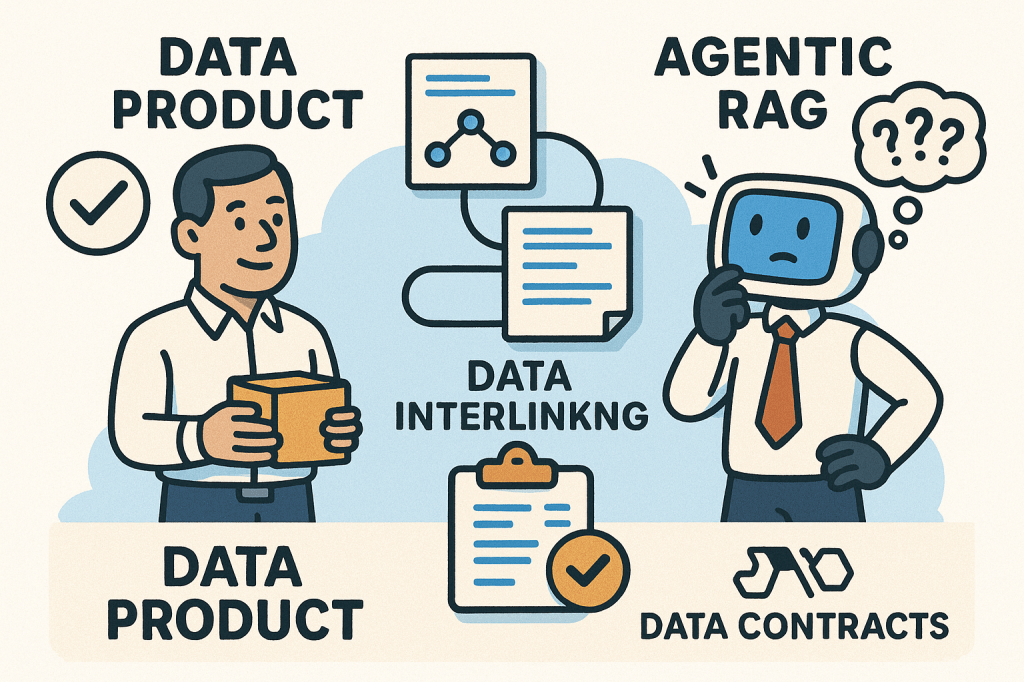
Agentic AI is exciting because it doesn’t just answer questions — it can plan, retrieve information, and even take actions.
But in real companies, especially in regulated industries, it often fails for one simple reason:
It doesn’t understand context well enough.
Why “just RAG” breaks in enterprises
Classic RAG pulls “relevant” snippets from documents or datasets. That can work in simple cases, but in large organizations it quickly gets messy:
- The same term means different things in different teams (“customer”, “active policy”, “claim cost”).
- Definitions change over time, but old logic still gets retrieved.
- Nobody knows which source is “official”.
- Access rules and approvals matter — and AI can’t guess them safely.
So you get confident answers… that might be wrong, outdated, or not allowed to be used.
Data products fix the “trust” problem
A data product is basically “data with responsibility.”
Not just a table — but something that has:
- a clear owner
- a business definition
- a known interface to consume it
- quality and freshness expectations (SLA/SLO)
- governance metadata (who can use it, for what purpose)
For an AI agent, that’s huge. It turns a chaotic data landscape into a set of trusted building blocks.
The real game-changer: contracts between data products
Most systems connect data through simple linking: “these keys match.”
Data contracts between products go further: they explain the relationship in business terms and set expectations, like:
- which version fits with which version
- required freshness and quality checks
- rules for how products can be combined
- lineage and traceability
This means an agent doesn’t just “find data”. It can follow safe, meaningful pathways across products.
What Agentic RAG looks like with data products
Instead of “retrieve random chunks and hope,” an agent can do:
- Discover the right products via a catalog
- Check access and approvals (owner decides)
- Validate quality/freshness against the product SLA
- Use product-to-product contracts to combine them correctly
- Answer with traceability: which products + which versions were used
That’s the difference between “AI demo” and “enterprise-ready AI”.
Why this matters in regulated industries
In health and insurance, you need to be able to say:
- Where did this number come from?
- Who owns it?
- Is it current and valid?
- Was it allowed to be used for this purpose?
Data products + contracts give you those answers by design.
A simple way to start
Don’t boil the ocean. Start with a small pilot:
- create two data products
- define one contract between them
- add minimal SLA metadata (freshness, quality)
- let an agent use only those products and enforce checks before responding
You’ll quickly see better trust, faster analysis, and fewer debates about “which number is correct”.
 Data As A Product Guy
Leave a comment